Posts mit dem Label Practical points werden angezeigt. Alle Posts anzeigen

Montag, 28. Oktober 2013

Dogs in hotels

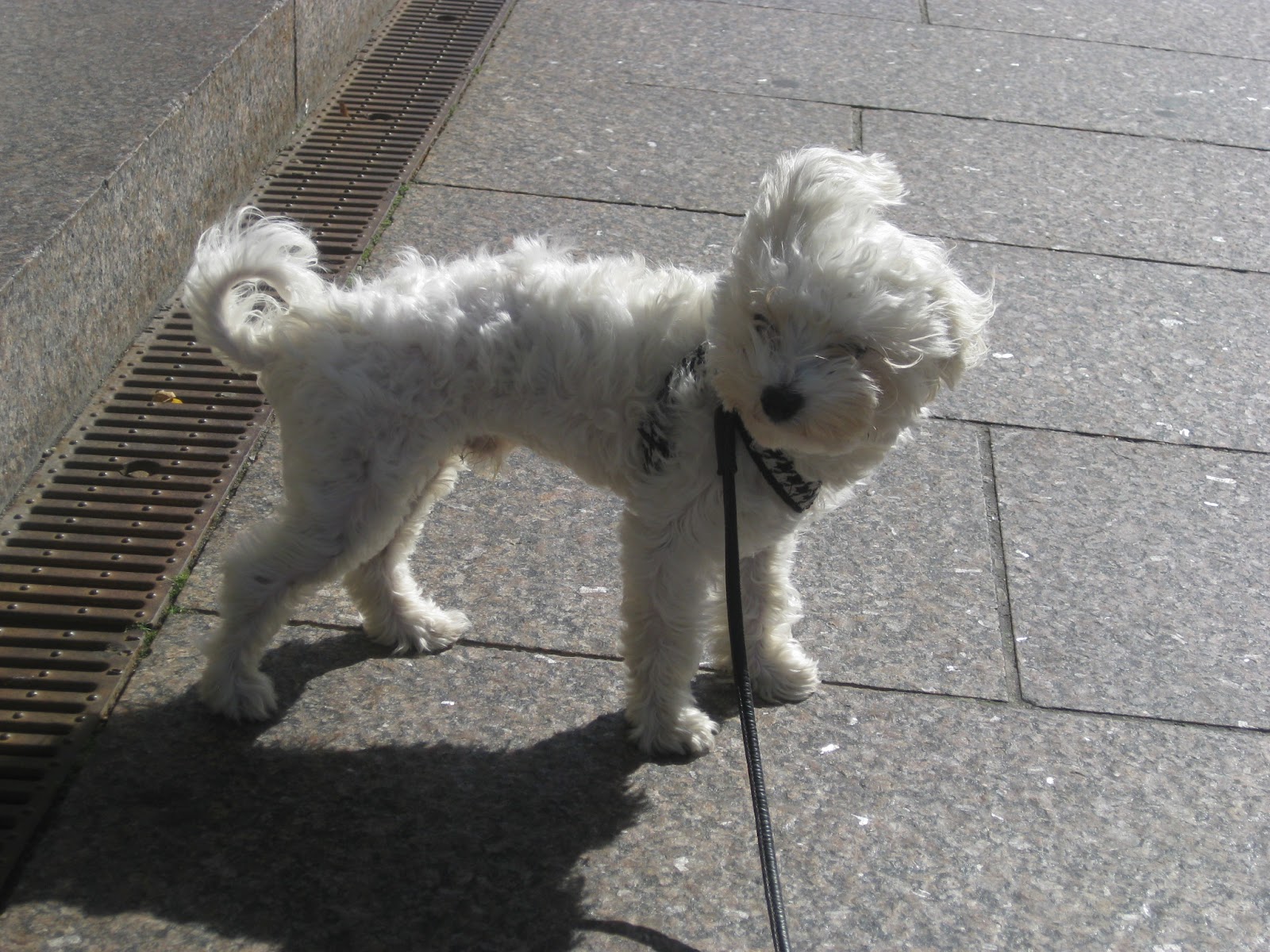
It was very nice of this hotel to put out a bed for Fritz.  Little do they know he sleeps in my bed ...


A couple of times there have been hotels that have asked me not to let Fritz stay alone in the room.  This can present challenges.  Sometimes he's allow to come to meetings with me, but sometimes he needs to stay.  Also, he does not like to be alone and will bark.  A lot.

My solution is that Fritz is crate-trained.  In addition to his Sherpa bag, I have a transport kennel that we bring with us.  It's kind of a pain to have one more thing to carry, but it's worth it.  Fritz is quiet when he's in the kennel and most hotels just don't want to have a loose dog in the room unattended and will let you leave your dog if he's kennelled. Usually, too, the airlines will not charge extra for the kennel, as it is empty and very light when it is checked in.


Dogs in airports


Some airports are very dog-friendly, especially Stockholm-Arlanda, our home airport. When we went up to the KLM desk to check in for a flight to Amsterdam we were welcomed with 'we've been expecting you.'  Other times, we've been let up to the front of queues and, well, they're just great.  Cabin staff on another flight were most understanding when Fritz escaped from his bag and started running up and down the aisle ...


Unfortunately, US airports we found were not so dog-friendly.  Most places have dog relief areas, but they're outside of security and can be a hassle to get in and out of.  After a total of about 13 hours (getting to the airport, flight, going through customs and immigration) Fritz ended up peeing in baggage claim in Newark. And most US airport have carpet... 

Anyhow, I've been yelled at for letting him walk around in Newark and Atlanta which I think it quite unfair. If you have a three hour layover after an eight hour flight, it's not fair to keep a dog cooped up in his bag :-(


Mittwoch, 23. Januar 2013

Getting into the UK - Update

As of 2013, P&O Ferries no longer allows footpassengers to bring dogs.  This means you must hire a car and drive it across the Channel on the ferry.

Supposedly the Dutch Flyer is another option, going between Amsterdam and London.  We don't have any UK travel planned soon, but I am sure we will try this in the next few years.

Sonntag, 23. September 2012

Helsinki - September 2012

Helsinki is windy.


I was only in Helsinki for about 25 hours for two meetings but it was a learning experience for several reasons......

Firstly, do your homework on 'dog friendly' places.  Like Stockholm, Finland has some great outdoorsy places, but slightly draconian laws about dogs near food.  We got kicked out of an outdoor cafe.  And out of the restaurant in the airport (although the staff very kindly served us outside in the outer-bar area).  I have never been kicked out of an outdoor cafe or an airport restaurant!!!!  I talked to our hotel concierge about this and he explained that the regulations are very strict on this, although there are moves to have it changed.  If I had done my homework and read these sites on 'pet-friendly Finland' beforehand, it might have been a smoother trip:

https://de.foursquare.com/user/1212139/list/dog-friendly-cafes-and-restaurants

http://www.petguidefinland.com/111


Secondly, taking the ferry to Finland was an option I explored (Viking Line takes dogs), but I didn't have a place to put him whilst I was at my meeting.  And in any case I ended up requesting a late check out....

...so, thirdly, consider researching pet baby-sitters.

Finally, do you homework with entry requirements!  There is freedom of movement  (of people) within the Schengen Zone, but customs officials should still check dogs and cats.  Fortunately (in this case) this does not always happen and there wasn't even a customs official on the desk when we landed in Helsinki.   I had sort of assumed that entry requirements within Schengen were the same and that all I needed was his passport with proof of rabies vaccination.  Actually, dogs need to be treated for tapeworm same as for entry into the UK.  I found this out after I got home and was researching....also, Norway has also introduced tapeworm treatment for movement between Norway and Sweden.  However - unlike entry into Finland or the UK which requires a veterinarian's stamp, you can administer the treatment yourself and sign a form 'on the honour system.'

The point is - check at least a week before you travel on the 'official' site.  The Norwegian Ministry of Foreign Affairs site still states there are no restrictions between Norway and Sweden but the Food Safety Authority has the updated information.  Similarly, About.com is incorrectly states that no tapeworm treatment is needed between Sweden and Finland, but the their Food Safety Authority (sort of) clearly states that this is required.


Freitag, 24. August 2012

Practical points - Dogs on trains

Fritz likes to ride on trains.

Each country's rail service is a bit different when it comes to trains.  In Sweden, dogs must be pre-booked as there is one carriage designated for dogs.  In the UK dogs can ride anywhere (although if the dog is taking up a seat or you have multiple dogs you may be charged extra).  In Switzerland, tiny dogs are free, whilst small and large dogs need a 1/2 price ticket.   Apparently dogs in Belgium cost up €2,20 but I have never been charged.  Similarly, pets on French rail cost €6 if in a bag and the cost of a 1/2 price ticket if on your lap/nearby you but I have never been charged either.

Generally assume dogs are allowed - except for the Eurostar which is absurdly dog-unfriendly in contrast to all the other rail services.  Still a good idea to check the websites before you travel for more updated information.

Swiss rail
SJ (Sweden)
Deutsche Bahn
National Rail (UK)
Belgian Rail
French Rail


Sonntag, 10. Juni 2012

Practical points - small dogs vs big dogs

This blog is based on my experiences with Fritz, who weighs about 3kg and fits into a handbag.  There have been a few occasions when we’ve been let into places where dogs aren’t normally allowed because he is so tiny.  I have also been let into places because no one notices that I had a dog in my handbag. As I travel, I try to keep an eye out for big dogs, but I have to say this is all based on having a small dog.


There are a few things to keep in mind. Some trains – for example Swiss rail – charge up to half price for a dog, but if your dog is tiny and fits into a bag, then he is free!

Overall, I would say that if you have a small dog you should travel normally.  If you have a big dog you should take this into account and plan your travel around him or her. 

Practical points – does your dog travel well?


Travelling with a dog is great, but before you bring him or her along, have a think.

Fritz’s first time on public transportation was taking the T-bana (Stockholm metro) home with me when he was two months old.  We spent our first day together at home, and the he started coming with me to work every day.  We get around Stockholm  via T-bana, commuter train, bus and bicycle – and he usually just falls asleep.  Also, since he comes to work he’s been very socialised from an early age.  This is not to say he’s a well behaved dog (he’s quite naughty at times), but he’s good in public and with people. And usually in restaurants he just chills out or sleeps under the table with his moose.


I would argue that because dogs in Europe are allowed more places, they are naturally more socialised – and better behaved.  So before taking your dog on holiday, think seriously about how well he or she does in the car or being out in public. 

Also, always bring food, a bowl for water and toy/pig’s ear/bone when you’re out.  Dogs are like children and need to be amused and taken care of or else they act up.

Practical points - what season?

Because Fritz and I travel for work, we go rain, shine or snow.  But if you’re planning a holiday then you have options  - and I would highly suggest going when it is nice, even if going off-season might save money.  And for a couple of reasons:

1.     Dogs can almost always be outdoors.  Even in countries in which dogs do not have the full run of the place (think England or Sweden), they can almost always sit outside at cafes.  So try and travel when outdoor eating is a realistic option.

2.     Fritz is behaves very badly when he doesn’t get enough exercise.   Even at his size, he needs a lot of play time.  When you’re travelling, you really can’t afford to have your dog acting up and being naughty, so it’s extra important to walk them enough. Naturally, this is more fun when it’s warm and sunny!  And walking the dog is a great way to see a city!

In Northern European, being “too hot” isn’t a real concern, but in Southern Europe it can be.  So also think about heat exhaustion and checking out warm countries in the autumn, spring or even winter.

Practical points - hotels


Finding pet-friendly hotels in Europe is not a problem. And it’s not in the US where a lot of hotels are either low-end and/or on the outskirts of towns. I tend to use booking.com which has a box you can tick for “pets” when you search for hotels. 

Fritz and I have stayed in some great places.  Our favourite is Hotel du Pillon, in Les Diablerets, Switzerland. 


In London, we love the Citadines chain of self-catering apartments. The point is – yes, some hotels don’t allow dogs, but plenty do.  Your dog should be crate trained, though.  It’s a good idea, and required by hotels, to keep him crated when you’re not there.  Also a lot of hotels charge a bit more per night, around €10/£10.

There are also some hotels that specifically bill themselves as pet friendly and/or designed for dogs.  We’re looking forward to visiting these in future journeys.

Practical points - getting a Dog into the UK


UPDATE - as of 2013 P&O Ferries no longer allows foot passenger to bring dogs!!!

This blog is predicated on the idea that that travelling with a dog is easy.  The one exception is getting a dog into the UK.   Dogs cannot fly in the cabin into the UK.  They must go as cargo – which is a hassle and costs up to €1000 each way.  So the ferry is a better option.  This is a bit of a long post, but here goes:

We fly from Stockholm to Brussels, then take the TGV (high speed train) to Lille- Europe, transfer to Lille-Flanders and take the slow train to Calais-Ville.  From there we cross the English channel with P&O Ferries to Dover.  Then take the train to London.  If we’re lucky, we land when there is a high speed train to London (High Speed 1).   Otherwise we take the slow one.  There is also an option of taking a TGV directly from Brussels to Calais-Fréthun.  Calais-Ville is the main station in town and Calais-Fréthun is in the middle of a field and a 25minute cab ride away.

(You might ask – I thought the Eurostar runs directly from Brussels to London in 2 hours 9 minutes?  It does, but it doesn’t take dogs.)

There are other crossings  than Calais-Dover.   There are longer ferries between France and Spain and the UK as well as from the Netherland and Belgium.  Some of these claim to be dog-friendly; others are less so.  Also, not all ferry lines allow dogs with foot passengers and instead you are required to have a car and leave your dog in it.   So there are options, but crossing between Dover and Calais is probably the easiest (and certainly the fastest) crossing. And there are other upsides:

Lille-Europe and Lille-Flanders  stations are about 10minutes walking distances form each other (the Deutsche Bahn website suggests 20 minutes).  Between these two is a park, which is a perfect place to walk the dog.  Depending on which train combination you book, there is usually about an hour between trains, so just enough time to get a snack and get the dog some exercise.


From Lille-Flanders you take the train to Calais-Ville, then you can get a cab to the ferry terminal.  Calais-Ville is just round the corner from the town hall, a tourist site in its own right and an UNESCO World Heritage Site.  There is also a lovely park.  Then you can take a cab to the ferry terminal.

The ferry and dog situation itself can be a bit ridiculous.  Each time I’ve boarded (3x) the protocol has been different.  Sometimes they allow me to board with the rest of the foot passenges and I take Fritz below onto the car deck. (He has to stay here with the cars during the journey and can't be above with me). Other times I’ve been driven onto the car deck.  I STRONGLY suggest you book one of P&Os Pride class ferries – when you book it will be obvious.  I find the Spirit class too big and there are massive freight vehicles on the car deck and I just find it’s a bit scary.  On the Pride class the crew are really friendly and it’s a smaller, less overwhelming place.  Usually they let me stay with him until we leave the harbour.  Also, you need to have a hard crate because they put the dogs (in the crate) into a secure-ish trolley during the crossing.


The overall point is that if you are planning a holiday, I would suggest one week in France, Belgium or Northern Spain and another week in the UK.  The other point is that I usually do this trip in 2 days (it’s easier) with a lay-over in Brussels but I’m hoping to do future lay-overs in Calais or Lille and explore them a bit more.

Samstag, 9. Juni 2012

Practical points - flying


The basic rule is that if your dog + his carrier bag is 8kg or less, he can come in the cabin with you.  He also needs to fit under the seat for take off and landing.  If your dog is bigger he has to go in the hold.  You should check with your airline first for exact requirements.  Typically the bag must be zipped shut, but have mesh so he can see out and breathe.


Dogs are actually meant to be under the seat during the whole flight, but this is negotiable.  So far we’ve only flown SAS and they’ve been great.  I was on a very empty flight and they let him sit on the seat next to me.  Other times he’s sat on my lap. I usually check his hard crate so I can crate him in the hotel and if it’s empty, they don’t charge me an extra baggage fee (in addition to my suitcase) when I flight out of Stockholm (Arlanda).


You’re only meant to have the dog bag and no other carry-ons, but I’ve also found this is loosely enforced by airline officials.


Practical points – quarantine


A lot of people are unclear about quarantine rules.  The short version is that things are much easier now and, generally, your dog does not need to be quarantined.  Within the EU, pets are issued passports by a veterinarian.  In the US, they are issued travel documents, but not an actual passport.  You should allow 6 months to complete the process in the first instance, but this can be shorted.  For instance, my vet gave Fritz a one-dose rabies vaccination instead of a two-dose vaccination that would have been spread over two months.  This shortened the process and he was able to make an international trip at about four and a half months old.

The process does change regularly, so you should check with the country’s department of agriculture and/or border agency before you book your travel.  You can find more information here.